You describe what you want to AI and, seconds later, you have working code. That's Vibe Coding, and honestly, it feels like magic. But like all magic, there's a trick to it. We sat down with Midudev to separate the show from the serious work: where Vibe Coding ends and Vibe Engineering begins.
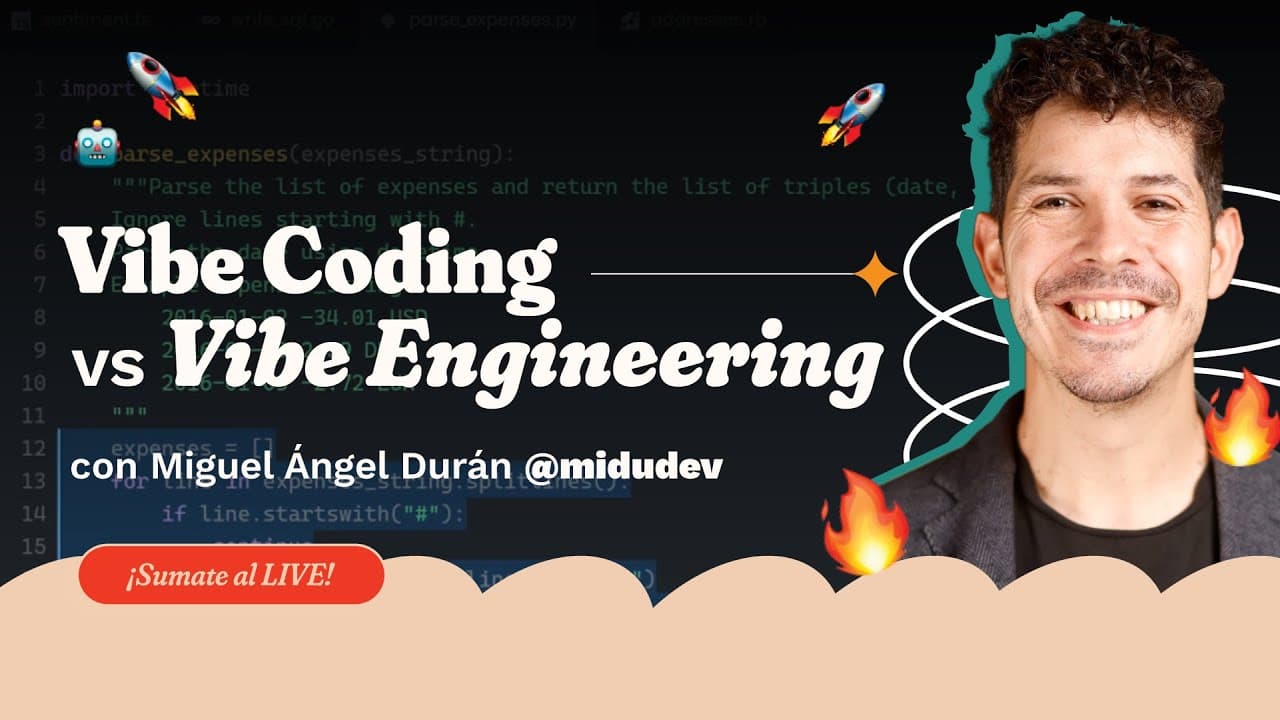
Vibe Coding: fast, fun, and risky if you stop there
Vibe Coding is great for prototyping, exploring an idea, or breaking through a block. You describe the what and let AI propose the how. The problem shows up when that code leaves the experiment and goes to production without anyone really thinking it through: no architecture, no tests, no one accountable when something breaks at 3 a.m.
Vibe Engineering: when judgment comes back to the center
This is where, as Midudev puts it, things get serious. Vibe Engineering takes all that AI speed and adds what makes it sustainable: design, architecture, tests, and technical responsibility. It's not about writing less code, it's about knowing which code deserves to exist. Specificity (prompting well, with context) ends up being your most valuable skill.
Human intelligence is still the key
The talk's conclusion is both reassuring and demanding: AI iterates fast, but the judgment to decide what to build, how, and why remains human. The developers who really stand out aren't the ones who fear AI or the ones who delegate everything to it, but the ones who use it with their head on straight. At Howdy, that's exactly the kind of developer we're looking for.
Watch the full talk with Midudev
Hit play to see the live examples and how to iterate fast and creatively without losing control. And if you want to grow as an engineer working remotely with top-tier teams, check out the opportunities at Howdy.
Before committing to a vibe coding or vibe engineering approach, it helps to know your tools. Here's a breakdown of the best AI tools for coding, evaluated by engineers.